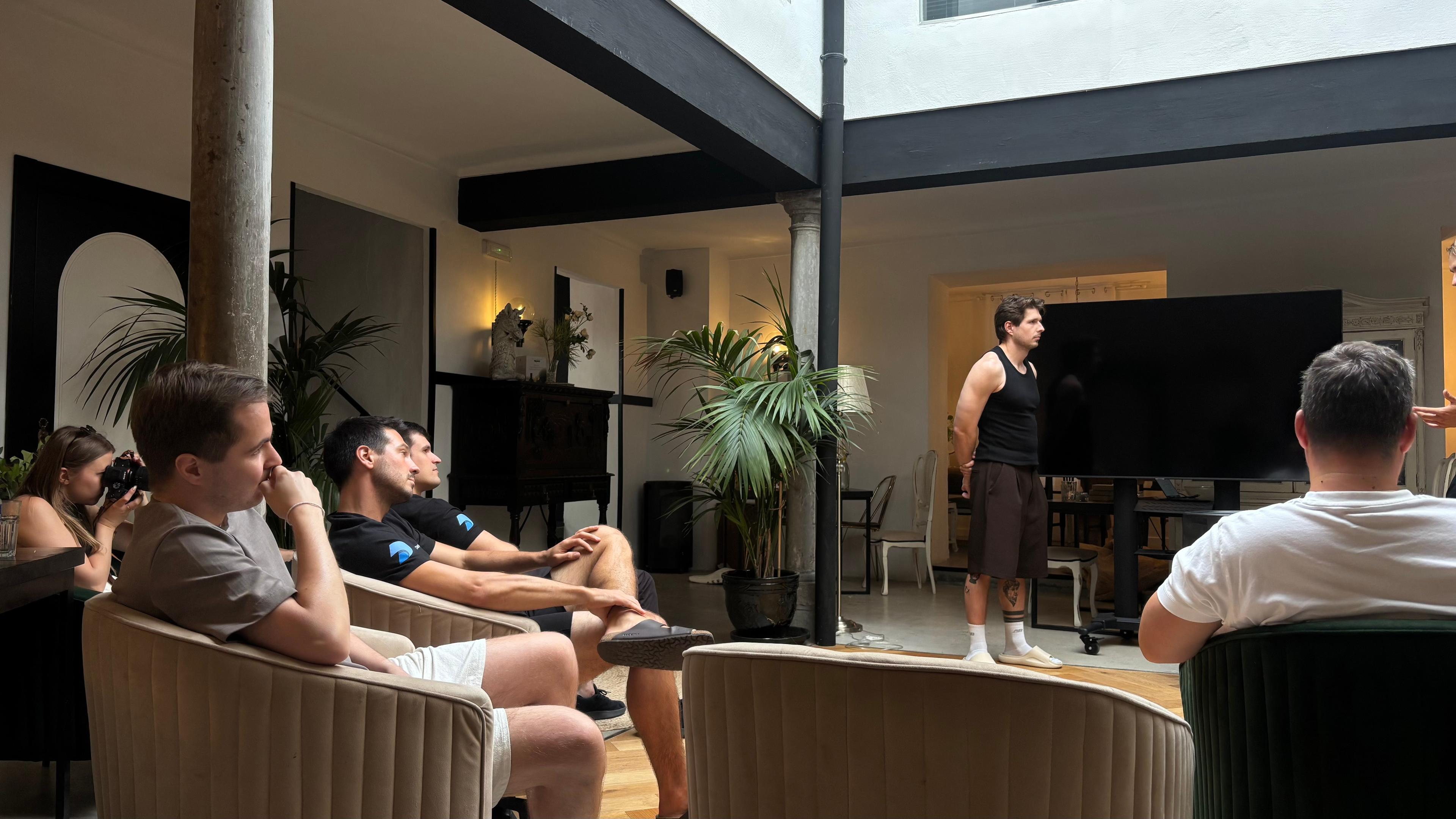
Team Building for New Teams Starts With the Right Offsite

A newly formed team can have talented people, a clear business case, and plenty of enthusiasm, while still having very little idea how to work together.
Who owns which decisions? When should something be a Slack message rather than a meeting? How does one person like to receive feedback? Who needs to be consulted before a project moves forward? What does good work from this team look like?
The questions tend to get answered eventually. But the problem is that teams often answer them through weeks of crossed wires, duplicated work, frustration, and meetings that expose assumptions nobody realized they were making.
This all gives the first team offsite a useful job to do. Team building for new teams should give people time to understand why the team exists, what everyone is responsible for, how they want to work together, and who the people behind those roles are.
The offsite doesn’t have to solve every aspect of new team development in two or three days. It should give the team a much better starting point.
A new team offsite needs a job beyond introductions
Getting everyone into the same place is useful. Spending the first morning on introductions followed by a sequence of leadership presentations is a missed opportunity.
McKinsey has argued that team kickoffs deserve particular attention when organizations stand up new teams. Its guidance specifically points to aligning team and individual goals and clarifying personal working preferences. MIT makes a similar case for formal kickoff activities that help teams define their mission, deliverables, roles, responsibilities, and measures of success.
This is where a team offsite can do work that’s harder to squeeze into a collection of normal meetings.
People have protected time. They’re away from the usual stream of calls and immediate tasks. Conversations can continue over lunch or a walk instead of ending when the next calendar notification appears.
Before building the agenda, decide what should be clearer when everyone goes home. Put purpose before the company retreat agendaand work backwards from what you want the new team to understand, agree on, or be ready to do afterwards.
For a newly formed team, that purpose might be:
By the end of the offsite, everyone should understand what this team is responsible for, how their role contributes, how decisions will be made, and the working agreements we want to test over the next 90 days.
That is far more useful than “bring everyone together for some team building.”
Team building for new teams should clarify roles and goals
It’s difficult to build a team around a vague understanding of why it exists.
This part of the offsite should come early, before activities and before detailed discussions about communication tools or meeting cadence. People need a shared picture of the work before they can decide how best to do it.
Turn the team’s purpose into clear goals
Senior leadership may already have decided why the team exists. That doesn’t guarantee everyone interprets that purpose in the same way.
MIT recommends that new teams discuss what they were brought together to do, what should be different because the team exists, and what a successful outcome will look like.
Use the offsite to make those answers specific.
Instead of spending an hour presenting a strategy deck, give people the context they need and then let them work with it. Ask them to identify the outcomes the team owns, the work that sits outside its remit, and the priorities that should guide trade-offs when several things compete for attention.
A short final document is more useful than another 40-slide presentation. It might contain the team’s purpose, 3–5 current goals, the main stakeholders it serves, and a clear statement of what the team does not own.
Clarify roles before ambiguity becomes friction
Job titles rarely explain enough.
Two people may both understand their own roles perfectly and still have different assumptions about where one person’s authority stops and another person’s begins.
That’s why team building for new teams should include practical role clarity. A 2025 review of workplace socialization researchfound that role clarity is an important part of helping people adjust to a new working environment, alongside social acceptance, task mastery, and a sense of fit. For a newly formed team, that’s a good reason to use some of the offsite to make responsibilities and expectations clear.
For each role, work through questions such as:
- What decisions can this person make independently?
- Where do they need input, approval, or specialist advice?
- What information do they need from other team members to do their job?
- Where are the obvious handoffs between roles?
- Who owns the final call when responsibilities overlap?
You’re not trying to write everyone’s job description again. You’re finding the bits where confusion is most likely.
Use the offsite to create working agreements
A new team starts with personal habits already in place. One person likes to answer Slack messages immediately. Another protects long periods for focused work. Someone likes detailed written feedback, while someone else would rather have a five-minute conversation.
None of those preferences is inherently right or wrong. Trouble starts when people assume everybody works the way they do.
New teams benefit from agreeing early on how they’ll work together. That means making expectations around communication, collaboration, availability, and decision-making explicit rather than leaving people to work them out as problems arise. Atlassian recommends creating these kinds of working agreements when teams are new or going through change. That makes working agreements a practical place to start.
Discuss the situations that create friction
Avoid producing a list of vague values such as “communicate openly” or “respect each other’s time.” Everyone will agree with them, and nobody will know what they require on any given workday.
Talk about actual work instead.
| Discuss | Turn it into an agreement |
| Communication channels | What belongs in Slack, email, your project tool, or a call? |
| Response expectations | Which messages need a quick response, and which can wait? |
| Focus time | When should people avoid scheduling meetings or expecting instant replies? |
| Meetings | What needs a meeting, and what should be handled asynchronously? |
| Decisions | Who decides, who contributes, and how is the final decision recorded? |
| Feedback | How do team members prefer to give and receive it? |
| Escalation | When should an issue be raised, and with whom? |
| Availability | How will different working hours or time zones be handled? |
For distributed teams, this can clear up a lot of ambiguity before misunderstandings become routine.
Treat preferences as information, not demands
Working preferences are useful because they tell colleagues something they couldn’t otherwise know.
“I concentrate best in the morning, so I try to protect my first 2 hours” is useful information.
“Nobody can schedule a meeting with me before 11” may be an individual preference that the rest of the team simply cannot accommodate.
The aim is to agree on shared ways of working that are realistic for the whole team. Where preferences differ, Atlassian recommends finding compromises rather than expecting everyone to get their first choice.
Make the first agreements temporary
A team that has barely worked together cannot know exactly which processes will work.
So don’t present the offsite’s working agreements as a constitution.
Agree on what you’ll try. Set a date to review it. After 30, 60, or 90 days, the team can ask what has worked, what creates unnecessary friction, and what needs changing.
That turns the offsite into the start of team development rather than an attempt to finish it.
Give relationships as much attention as processes
There is another risk when forming a new team: turning the offsite into one long operating-model workshop.
Roles and processes are important, but so are the relationships people will rely on afterwards. Research also points to social acceptance and meaningful interactions with colleagues as an important part of adjusting to a new working environment.
So leave room for people to talk, spend time together, and get to know the people behind the job titles.
Help people understand the person behind the role
You don’t need forced vulnerability or an elaborate “bonding exercise.” Give people enough space to learn things that make future collaboration easier.
Pair people who will work closely together and give them a few prompts:
- What part of your role will this team probably see most often?
- What tends to slow you down when working with other people?
- When you disagree with someone, how do you usually approach it?
- What expertise or experience do you have that might not be obvious from your title?
Rotate the pairs rather than keeping people in their existing departmental groups.
The relationships people build with one another are just as important as the relationship they have with the team leader.
Leave room for conversations you didn’t schedule
A new team offsite doesn’t need activity from breakfast until dinner.
Some of the most useful relationship building happens between formal sessions: over breakfast, during a walk, while traveling to an activity, or when four people stay at the table after lunch.
Protect some of that space.
You still need enough structure that people don’t spend three days drifting between meals. But if every 30-minute block is allocated, you remove the informal time that helps people become more than names attached to roles.
Don’t turn the offsite into an onboarding data dump
There will be a temptation to use the fact that everyone is together to explain everything.
Company history. Processes. Systems. Strategy. Policies. Stakeholder maps. Product demonstrations. Department updates. Reporting lines. Every internal acronym anyone might encounter.
By day two, you have turned a team offsite into a conference.
People need enough information to understand the team and participate in the conversations you’re asking them to have. Information they can read later doesn’t automatically deserve valuable time together.
A useful test is to put every proposed session into one of three buckets:
- We need to discuss this together. Keep it in the offsite.
- People need this information, but discussion isn’t necessary. Send it before or after.
- People don’t need this yet. Leave it out.
This is especially important when forming a new team because almost everything is new at once. An overloaded agenda can create the appearance of progress while giving people very little time to process, question, or apply what they’ve heard.
Make participation part of the design
New teams often have uneven confidence levels from the beginning.
Some people already know each other. Others have just joined the company. A senior leader may be in the room with people who have never spoken to them. Strong personalities can easily set the direction before quieter team members have decided what they think.
That makes facilitation important.
Don’t end a presentation with “Any thoughts?” and wait for whoever speaks first.
Use pairs, small groups, individual reflection, written input, and structured discussion so more people have a route into the conversation. One option is 1-2-4-All, which moves people from individual thinking into pairs, groups of four, and then the whole room.
This is especially useful for topics such as working agreements, team priorities, and potential friction points. You want to know where people disagree while there is still time to talk about it.
Build an agenda around outputs, not session titles
Once you know what the offsite needs to accomplish, the agenda becomes much easier to build.
For a newly formed team, a two-day working agenda might look something like this:
Day 1
- Set the context and purpose of the team.
- Agree on the outcomes the team owns.
- Clarify roles, responsibilities, and major handoffs.
- Make time for an activity or informal shared experience.
- Have dinner together without another workshop attached to it.
Day 2
- Discuss individual working preferences.
- Create the first version of the team’s working agreements.
- Agree on decision-making and escalation.
- Work through one real problem together.
- Decide what happens next, who owns it, and when agreements will be reviewed.
The exact timetable will depend on the team. A leadership group forming after a reorganization has different needs from a new cross-functional project team or a remote team meeting in person for the first time.
The principle stays the same. Every substantial session should produce something the team can use after the trip.
Take the agreements back into everyday work
The real test of team building for new teams starts once the laptops reopen on Monday morning.
Before people leave the offsite, capture what was agreed.
That might include:
- the team’s purpose and current priorities;
- role boundaries and important handoffs;
- working agreements;
- communication and meeting norms;
- decision rights;
- named actions with owners and dates; and
- a date for reviewing what the team agreed.
Keep it somewhere people already work. A document nobody can find three weeks later is not much of an operating agreement.
And expect some parts to change.
In the early stages of team development, people are still working out structure, direction, roles, goals, and expectations. That process isn’t always linear either; changes in the team or its work can send people back to questions they thought they had already settled.
So, review the agreements after the team has enough real experience to challenge them.
The goal of the first offsite isn’t to create a finished team. It’s to reduce the number of important things people need to work out by accident.
For a newly formed team, that is time well spent.You’ve got enough to work through with a newly formed team. We can take care of the venue search, accommodation, meeting spaces, activities, and trip logistics while you focus on what the team needs to achieve together. Schedule a call with a Retreat Specialist to start planning your offsite.