Hybrid Team Building: Why Teams Still Need to Meet in Person

Hybrid teams have solved a lot of problems that previously required everyone to share an office. Status updates can happen in Slack. Documents can be reviewed asynchronously. And a project team can include people in London, Lisbon, and New York without geography being an obstacle.
Good hybrid team building starts by accepting all of that.
But there is still a case for bringing people together. Some kinds of work benefit disproportionately from people sharing the same room. And when you’re asking colleagues to cross countries and time zones for a team offsite, those are the conversations your agenda should protect.
Because flying everyone in just to sit around a conference table answering emails and joining Zoom calls is an expensive way to recreate an ordinary Tuesday.
Remote and hybrid work do plenty of things well
There’s no reason to turn every collaboration problem into an argument for more face-to-face meetings.
Distributed work gives teams flexibility over where they work and makes it easier to involve colleagues across offices and countries. Asynchronous communication can also be the better format when people need time to think, review information, or respond without coordinating calendars.
And for many hybrid teams, that means a surprising amount of normal work can stay exactly where it is.
Routine information doesn’t need a plane ticket
Think about the meetings already filling your calendar. You’ll find that plenty exist mainly to transfer information:
- status updates and project reporting
- sharing documents, figures, and announcements
- straightforward progress reviews
- routine operational coordination
- some forms of evaluation and decision-making once the options are already clear
Those tasks can often happen remotely or asynchronously without losing much value.
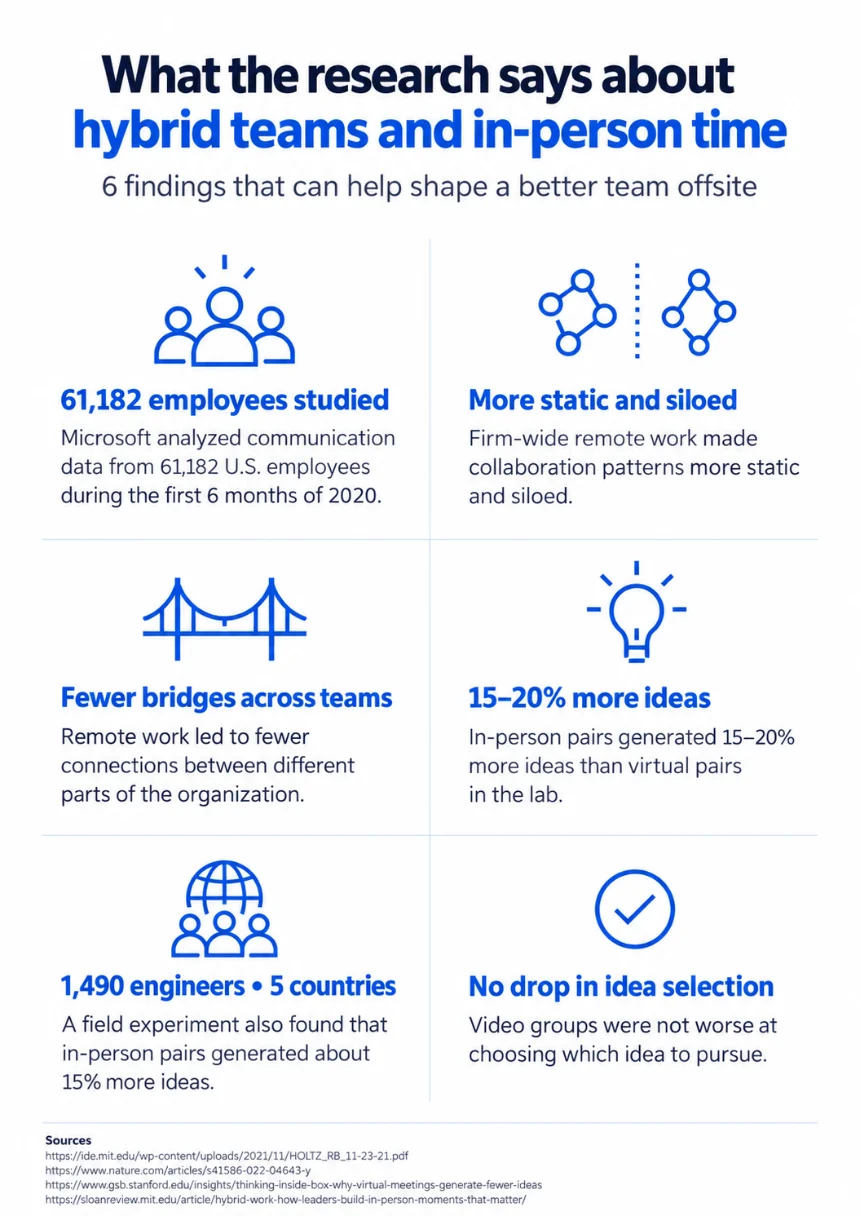
There’s even evidence that virtual communication isn’t uniformly worse for collaborative work. Researchers Melanie Brucks and Jonathan Levav found that pairs meeting over video generated fewer creative ideas than pairs meeting face to face. But when participants had to select which idea to pursue, the researchers found no evidence that virtual groups performed worse.
And it is this distinction that should influence how you design hybrid team building. Instead of spending the rare occasion when everyone is physically together reading slides that could have been emailed.
Hybrid team building needs to solve for the gaps between teams
Distributed work can create a problem that isn’t always obvious from within individual teams.
Your immediate team can be functioning perfectly well. Product talks to product. Finance talks to finance. People know who they need for their regular work, and established relationships keep moving.
But the bridges between those groups can weaken.
Researchers studying 61,182 U.S. Microsoft employees during the company’s 2020 shift to firm-wide remote work found that collaboration networks became more static and siloed. There were fewer connections bridging different parts of the organization. Employees also spent a greater share of their collaboration time with stronger existing ties. Weaker ties, which could still provide access to different information and perspectives, were afforded less time.
While it doesn’t suggest every modern hybrid team will develop the same pattern, the study’s findings do highlight a useful problem for leaders to watch. People can remain very connected to the colleagues they already work with, but they might have fewer reasons to form relationships elsewhere.
Strong teams can still create a siloed company
Imagine a growing business with engineering in one country, sales spread across several markets, and operations working remotely.
Within each function, communication may be excellent. But it might be nearly absent between different functions.
Does a salesperson know who in product to call when a customer raises an unusual issue?
Does someone who joined finance six months ago understand why operations handles a process in a particular way?
Do people from teams that rarely share projects know enough about each other to have an informal conversation before a small problem becomes a formal escalation?
Cross-functional collaboration can suffer even when individual teams are working well.
If planned properly, a hybrid team’s company retreat can deliberately create the encounters absent in normal remote routines.
Some work needs face-to-face time
When planning a team offsite, you shouldn’t be wondering what meetings to have while everyone is together. You should be looking at what work is going to be easier, richer, or more useful because everyone is physically together.
| Fine remotely or asynchronously | Better face to face |
| Status updates | Generative ideation |
| Information transfer | Ambiguous strategic discussions |
| Straightforward reporting | Relationship-building |
| Document review | Cross-functional sensemaking |
| Routine coordination | Difficult or sensitive conversations |
| Evaluating clearly defined options | Working through disagreement |
| Sharing decisions already made | Forming new working relationships |
Of course, this isn’t a rigid rule. Some strategy work can happen remotely, and some reporting belongs inside an offsite when it gives everyone context for what follows. But you should stop treating all work as equally deserving of scarce in-person time.
Use the room to generate
If people have traveled to be together, use that time for work that benefits from live exchange rather than presentations they could easily have watched from home.
Generative sessions are a good example. Give people a real problem to work on, a useful prompt, and a format that lets more than the loudest few voices contribute. If you’re not sure how to do this, we cover practical ways to structure those conversations in our guide to structuring discussion at a team offsite.
There’s a real opportunity to use the room for genuine generation, tackling problems where there isn’t already an obvious answer and where different perspectives need to collide.
Put ambiguous strategy in the same room
Straightforward decisions transfer well to a shared document, but ambiguous ones are harder.
“We need to choose between these two clearly defined vendors” is quite different from “Our customers are changing but three departments see the problem differently, and we need to decide what we’re going to do about it.”
The second conversation will include assumptions, disagreement, incomplete information, and probably some history. And for cross-functional teams, the value of meeting in person is often the ability to work through that mess together.
People can question an assumption immediately, sketch something on a board, pull another person into the conversation, or continue the discussion over lunch rather than booking another meeting for Thursday.
Create space for relationships that don’t exist yet
A distributed employee usually doesn’t need a hybrid team-building retreat to spend more time with the four colleagues they already speak to every day.
But they may need one to meet the people they rarely encounter. A name they’ve heard but never met. Someone in a job function they’ve always been curious about. The person behind the weekly reports they’ve come to rely on.
Identify the people and teams who rarely cross paths and design some of the offsite around them.
Mix tables at meals. Build working groups across functions. Pair people who depend on one another’s work but rarely speak directly. Give teams problems to solve with colleagues outside their normal reporting line.
For larger gatherings, getting everyone into the same venue is only the starting point. Smaller groups create more opportunities for real conversation and cross-team contact than one large audience ever will.
Don’t fly people across the world to put them back on Zoom
Where many hybrid team offsites go wrong is by either having an agenda that is too loose or structured more like a workday.
A leader presents for 45 minutes. Someone else shares quarterly results. There’s a one-hour department update, but now half the room has laptops open. During lunch, someone joins a Zoom meeting with a client, and several people spend the afternoon answering messages.
By 5 PM, everyone has technically been together all day, but without having done much together.
Brian Elliott makes a similar case in MIT Sloan Management Review. He describes hybrid workers making the trip into an office only to spend the day in conference rooms on Zoom, then leaving frustrated because there was no clear reason to be there. His point is that in-person time works better when it is built around specific moments that benefit from people being together, rather than around attendance for its own sake.
A team offsite should be even more deliberate. If people are crossing countries and time zones to be there, the agenda should be built around the work and relationships that gain something from physical presence.
Apply an “in-person test” to the agenda
Before approving a session, ask what changes because everyone is physically present.
If the honest answer is “nothing,” reconsider the session.
You can use 4 tests:
- Would this work almost as well as a document or video call? If yes, move it before or after the company retreat.
- Does it require people to build on one another’s thinking in real time? That’s a stronger case for keeping it.
- Does it bring together people who rarely work together? Protect it.
- Would greater trust, context, or conversational nuance change the outcome? Keep the conversation in the room.
This is especially useful when senior leaders submit agenda requests. A 60-minute presentation may feel important because the subject is important. But that doesn’t mean the presentation requires 60 minutes of face-to-face time. What might work better is to send the information first and then use the team offsite to debate what it means.
Design a hybrid team retreat around connections and content
If one purpose of the company retreat is rebuilding connections across hybrid teams, the agenda needs to give those connections somewhere to form.
A tightly scheduled conference can work against you.
People are likely to arrive at breakfast with their existing friends. During the morning sessions, they sit with their department. The seating stays roughly the same at lunch. Then everyone divides into familiar teams for breakouts.
You’ve gathered the company physically while leaving its collaboration network almost untouched.
Create deliberate cross-team contact
You don’t need awkward, forced networking. You need to give people useful reasons to work together.
For example, a customer experience problem could be worked on by groups combining sales, product, operations, and support. A planning exercise could mix senior and newer employees. A strategy session could deliberately bring together teams that normally encounter each other only at the point of handoff.
That type of cross-functional collaboration serves two purposes. It helps the immediate session, and it gives people a human connection they can use once they’re remote again.
Leave unstructured space as well
Not every useful connection comes from a workshop.
Shared meals, a walk between sessions, an activity, or 30 minutes with nowhere else to be can give people opportunities to continue a conversation that started earlier.
When looking at your agenda, that time can look unproductive. But it could easily lead to someone discovering what another team is working on, asking the question they didn’t want to raise in a group session, or finding a colleague who can help with a problem next month.
Give hybrid team building a specific purpose
A vague reference to improving hybrid team collaboration or bringing everyone together isn’t enough of a brief.
Decide which relationships or types of collaboration need attention before you start filling the agenda.
A useful objective might be:
Product, sales, and customer success leave with a shared understanding of the three customer problems they’ll prioritize next quarter, and each function knows who it needs to work with next.
That gives you enough to make decisions.
You can work out who needs to be in the room. You can decide which pre-reading needs to happen before the trip. You can decide which conversations belong on the agenda. And you have some basis for checking afterward whether anything changed.
Make the hybrid team retreat change what happens afterwards
A company retreat can reconnect a hybrid team for three days. But what happens when everyone opens their laptops from home again?
Did a new relationship survive the flight back?
Are two departments now talking directly instead of passing everything through their managers?
Does someone know who to message when they need context from another function?
Are people involving colleagues earlier because they better understand what those colleagues do?
That’s a better measure of team cohesion than asking whether everyone enjoyed dinner.
The goal for hybrid team offsite isn’t to recreate office life for a few days. It’s to strengthen the relationships and shared context that make distributed work easier for the months that follow.
Treat face-to-face time as a scarce resource
Hybrid work gives companies an opportunity to be much more deliberate about where work happens.
Keep the status meeting online. Share the report before anyone travels. Let people review the numbers in their own time.
Then use hybrid team building to do the harder work: generate ideas, work through ambiguity, repair weak connections, bring different functions into the same conversation, and build relationships that are difficult to create through scheduled calls alone.
If your company is bringing people across countries and time zones, make the journey genuinely worthwhile.
You’ve worked out why your team needs to meet in person. Now make the trip worth the time away from normal work. NextRetreat can help with venue research, accommodation, meeting spaces, activities, and the logistics around the trip. Schedule a call with a Retreat Specialist to start planning.